
How Holistic Therapy Works (and What to Expect)
Updated: Feb 8
When someone wants to know how therapy works, I understand that question. It’s such an intangible thing — even therapists struggle to explain it. 😋 So of course, if you’re thinking about starting therapy, you’re going to wonder what actually happens and how it helps.
Over the years, I’ve given different answers depending on where I was in my career. At this stage, this is the clearest way I can describe it. Holistic therapy unfolds in layers — it’s relational, embodied and transformative.
Below, I’ll walk you through the five phases of healing in holistic therapy, so you can better understand what the process looks like from the inside out.
If you’d like a closer look at what an individual session feels like, you can read my post on what to expect in a holistic therapy session.

Phase 1: Awareness and Relationship-Building
The very beginning stages of holistic therapy involve relationship building and awareness — me gaining more of an awareness of you and what your strengths, weaknesses and needs are and you gaining more awareness of yourself.
In holistic therapy, we do much more than build rapport. Rapport is the friendly surface-level connection — showing up on time, being kind and greeting you warmly. Relationship-building is deeper than that. It’s becoming attuned to your needs, your emotions and the subtle energies in the room. It’s co-creating a space where you can say anything, where you feel safe, seen and understood.
Quick story: When I was in graduate school, I took a class on working with diverse populations. I asked the professor "How do I build rapport with people who may not trust that I will understand their experience?" She walked around the room and briefly shook hands with a few students and made pleasantries. She said "that's rapport-building." Then she sat in front of me, with deep eye contact and a soft face and said "Tell me what it's like to be you" and took a long pause. She said "that's relationship-building." 20 years later, I'll never forget that embodied distinction.
In addition to relationship-building, we also set goals collaboratively, but goal-setting here doesn’t look like “write down your top three therapy goals.” It’s more exploratory. What’s causing you distress right now? If therapy really worked for you, what would your life look and feel like?
And we don’t just talk about reducing what’s not working. We look at increasing what you do want — more calm, more connection, more joy.
A typical holistic therapy session blends talk, reflection and somatic awareness. Sometimes we’re exploring your thoughts or relationships, sometimes we’re slowing down to notice what’s happening in your body and sometimes we’re connecting dots that help you see the bigger picture. Each session is different, because it follows you — not a script.
Phase 2: Uncovering
Once there’s safety and understanding, we begin uncovering. This is where we start to peel back layers of experience, emotion and history.
Sometimes that looks like remembering an early childhood moment that shaped you. “Oh wow, I forgot about that. My grandma always told me to be a good girl and not cry.” Sometimes there’s no specific memory, just sensations — a tightness in the chest, a flutter in the stomach — especially when trauma happened before words were available.
We’re uncovering memories, sensations, patterns and wisdom that have been living inside you all along.
It can feel tender or surprising, but it’s never rushed. We go at the pace your nervous system can handle. This is where the real self-discovery begins — seeing how old experiences show up in your current patterns and how your body still carries those imprints.
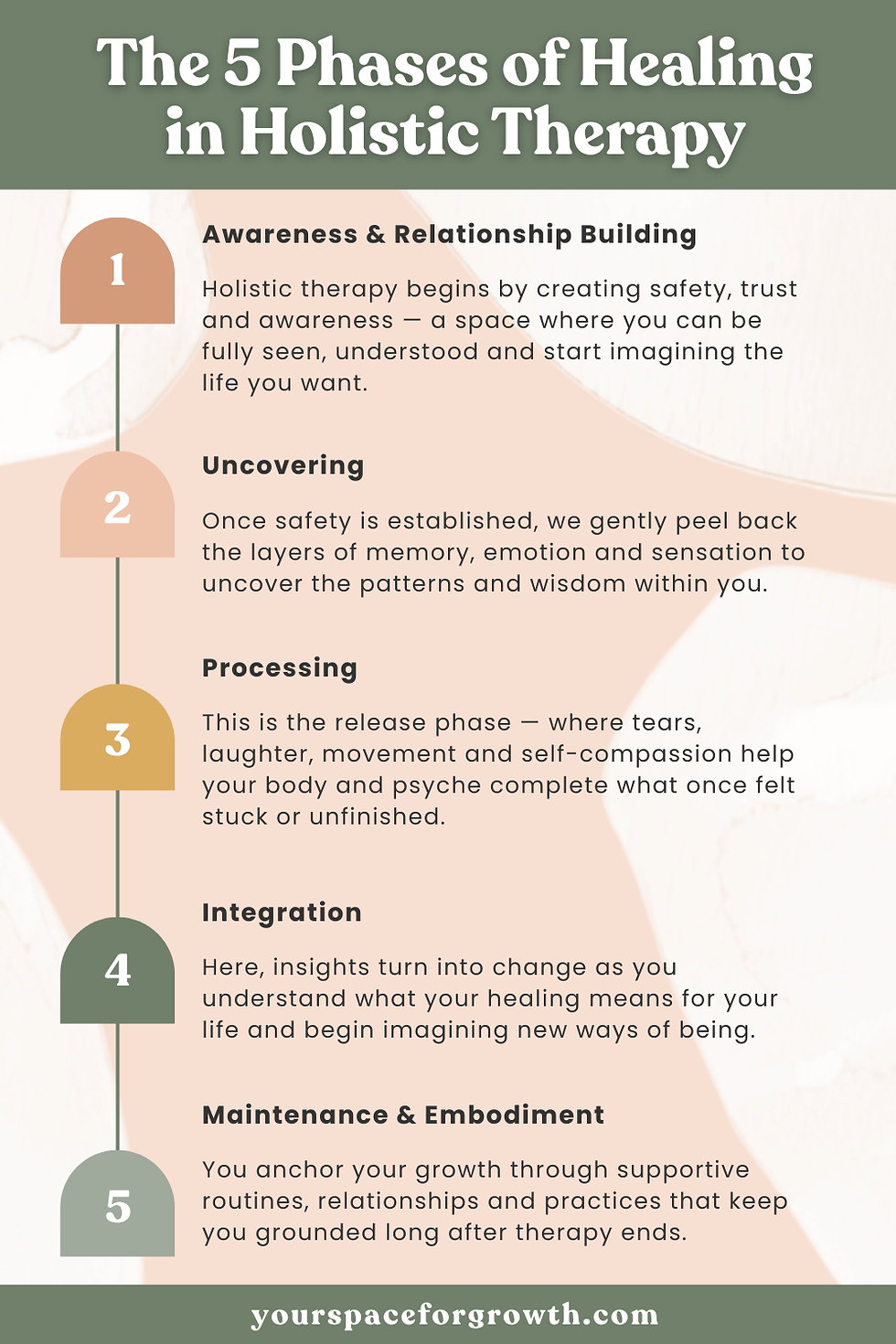
Phase 3: Processing
Then we move into processing — the phase where everything starts to integrate. This is where the tears, shaking, laughter and sighs show up.
Processing can look like telling the story of a trauma while being safely witnessed. It can look like following sensations in your body until your nervous system releases what it’s been holding. Sometimes it’s discharge, sometimes it’s reprocessing — whatever name you use, it’s the body and psyche completing what once felt unfinished.
It might mean meeting unmet needs — holding yourself in a comforting posture, giving your inner child the safety they didn’t have. Or, from an IFS lens, letting your parts speak to one another. The protector part, the exile, the manager — all beginning to listen, soften and move toward wholeness.
This is the part of therapy where something in you exhales for the first time in years.
A really big part of somatic work is tracking during sessions — having my ears, eyes and intuition tuned to what’s happening moment by moment. Your body shows me where to go. If you’re holding your breath, we go to the breath. If you’re clenching a muscle, we bring gentle attention there. If your eyes dart around or you grab a blanket, you’re communicating something without words.
Somatic tracking gives me the information I need to guide you — to see where your readiness, willingness and capacity for the work are in each moment. Some clients can drop into the body right away; others need to grow that ability. Either way, there’s always a starting point.
Processing is also where we might see those moments of discharge — the sigh, the yawn, the tremor, the tears, even the laughter that comes after a deep release. Those are the body’s ways of completing unfinished energy cycles and signaling safety again.
Phase 4: Integration
After the release comes insight. Integration is about taking the treasures and truths from the processing phase and understanding what they mean for your life now.
You might think, Wow, I can’t believe I carried that guilt for so long. You might start imagining your life without that weight. Maybe it means setting boundaries for the first time, letting yourself take up more space or redefining how you show up in relationships.
Integration is also where we start to act on what’s been uncovered. If your body has learned it’s safe to rest, maybe you start leaving work on time. If you’ve realized perfectionism was born from fear, maybe you let yourself be human — to make mistakes, take risks and live a bigger, freer life.
The pace is unique for everyone — some clients feel major shifts after a few months, while others stay longer to continue deepening and integrating what they’ve learned. There’s no rush or timeline to “finish” healing. It unfolds at the rhythm your body and soul are ready for.
Phase 5: Maintenance and Embodiment
In maintenance, we look at the systems and supports that help you sustain your progress. What routines keep you balanced? What relationships help you feel supported? Do you need more rest or more play?
We might talk about morning or evening routines, not as prescriptions but as explorations — what helps you thrive? What tools from therapy feel worth keeping for the long run?
Maybe the breathing exercise that helped you process trauma also helps you stay calm at the DMV. Maybe mindfulness or self-compassion practices become lifelong anchors rather than short-term tools.
Maintenance isn’t about closing the book. It’s about recognizing that what you’ve learned here — about your nervous system, your needs and your patterns — can serve you for the rest of your life. Therapy becomes something you can revisit whenever life brings new challenges, but now you come back with a deeper sense of trust in yourself and your capacity to heal.
Holistic therapy is not a straight line — it’s a spiral. Healing unfolds in layers. You circle around the same themes, but each time you do, you’re a few levels higher on the staircase. You see things from a new perspective. You’re not back where you started — you’ve evolved.
Sometimes a client will say, “I didn’t know I needed to cry about that.” Or, “I wasn’t expecting our session to go there, but I feel lighter.” Sometimes it’s as simple as both of us pausing mid-sentence and taking a deep breath that finally lands. Healing moments can look quiet ordinary, even surprising.
The Healing Arc
Interestingly enough, when people come into holistic therapy and leave holistic therapy, it’s not this exact one-to-one of, I came into therapy as an overthinker and I left therapy as someone who never overthinks. It’s not like that.
It’s more like: I came into therapy because I couldn’t stop overthinking and I left therapy feeling at home in my body again. I learned how to speak up for myself in relationships. I learned how to love the beauty of the present moment and trust the universe more. I learned how to experience safety even when life is uncertain.
That’s the deeper kind of transformation that holistic therapy creates. It doesn’t erase the human parts of you — it helps you live in harmony with them.

How Long Does Holistic Therapy Take?
It’s one of the most common questions people ask — and one of the hardest to answer. The truth is, there isn’t a single timeline that fits everyone. Therapy unfolds at the pace your nervous system, your life circumstances and your goals allow.
Some people come in wanting to work through a specific situation, like a breakup or work stress and feel significant relief within a few months. Others are unpacking long-term patterns or trauma that need more time, safety and support to heal.
I often tell clients it’s a bit like asking how long it takes to build a house — it depends on the size of the house, the materials, the number of people helping and what “finished” looks like to you.
That said, research gives us a loose sense of what’s typical. Studies show that many people start noticing meaningful changes after the first couple of months of consistent therapy and that deeper, longer-lasting transformation tends to unfold over time. One large review found that the average client attends around 12 sessions before seeing significant improvement, while others benefit from a longer course of work depending on what they’re exploring (PubMed).
So rather than asking how long will this take, a more helpful question might be what kind of relationship do I want to have with my own growth? Holistic therapy isn’t a quick fix — it’s an evolving process that meets you where you are and supports you in moving toward greater self-awareness, regulation and freedom.
How Will You Know Holistic Therapy Is Working?
When holistic therapy is working, things start to shift — both inside you and around you. Patterns that once felt automatic begin to change.
Let’s say someone asks you for help. In the past, you might’ve given a knee-jerk yes before even checking in with yourself. But over time, you notice that you pause. You take a breath. You ask, Do I have the capacity for this right now? Do I actually want to do this? That small moment of awareness — that pause — is a sign of growth.
You’ll also notice it in how you experience joy. You might feel more present in everyday moments, more grounded in your body, more connected in your relationships.
When stress hits, instead of becoming completely overwhelmed or shut down, you’re able to take care of yourself. You ask for the space you need, you prioritize what matters and you recover more quickly. You start to respond to life rather than react to it.
You may even find that something that used to trigger you just… doesn’t anymore. It’s as if you’ve become a bit more rubberized — what once bounced you into old habits now simply bounces off you.
Another sign of progress: your standards rise. You become more discerning about the people, situations and environments you allow into your life. The things that once drained you no longer get a free pass.
And perhaps most importantly, you’ll start to carry what you learn in therapy out into your daily life. Maybe you catch yourself using a breathing exercise in traffic before anxiety takes hold. Maybe you ground yourself before a difficult conversation. These are quiet, powerful indicators that the work is taking root.
These moments — subtle yet profound — are how you’ll know holistic therapy is working. Healing doesn’t happen all at once; it happens in layers, through countless small shifts that help you return to yourself.
Bringing It All Together
Holistic therapy isn’t just about reducing symptoms. It’s about expanding your capacity to feel, to connect and to live fully. It’s about bringing all parts of yourself into alignment so you can experience life from a place of presence, safety and self-trust.
If you’d like to understand more about how I practice this work, I recently shared my story and approach in an interview with CanvasRebel Magazine. It’s a glimpse into how I bring mind, body and spirit together in the therapy room — and why this approach feels so meaningful to me.
If this way of working resonates with you, I’d love to share more about what holistic therapy can look like in your life. Visit my Holistic Therapy in California page to explore how we might begin.

About the author:
Hi! 🙋♀️ I’m Natalie. A Los Angeles native, boy mom and the founder of Space for Growth Therapy & Coaching. I help high-functioning women who look capable on the outside but feel overwhelmed on the inside heal anxiety, burnout and people-pleasing through holistic therapy. If you're curious, here's where to learn more about me.
Comments